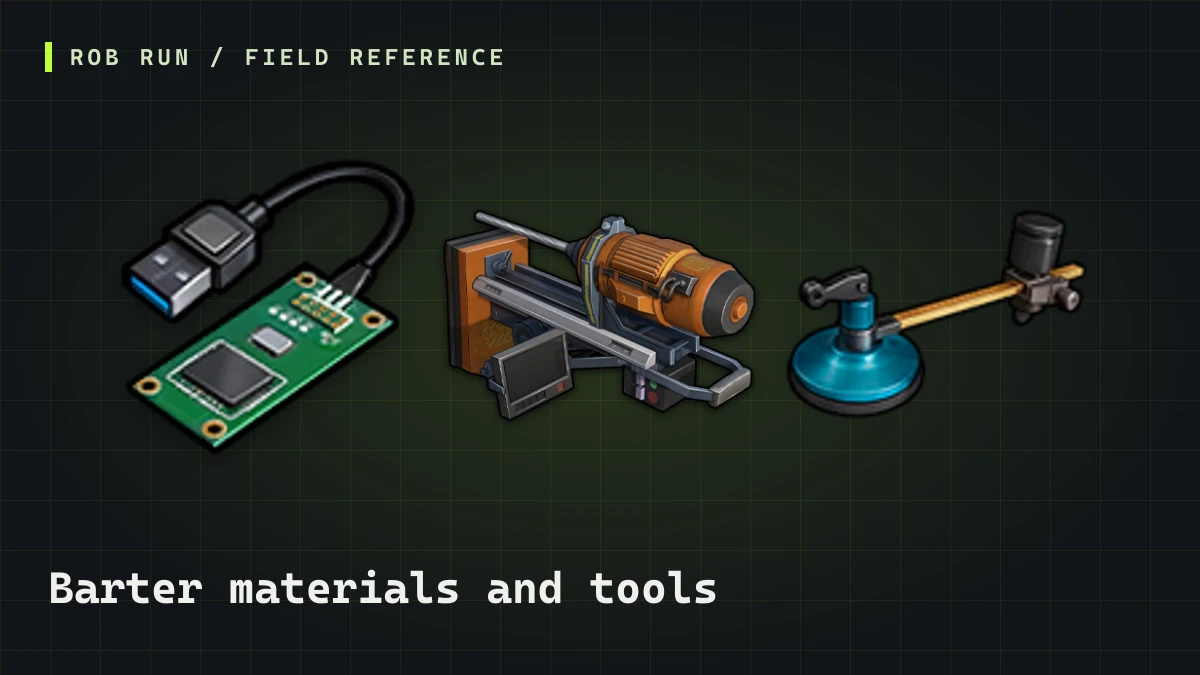
What does the snapshot say can be bartered?
The community barter page includes exchanges for a Drill, Glass Cutter, different IDs, Decoders, police badges and other progression items. This tells us what the snapshot cataloged; it is not proof all recipes remain active or their amounts are correct today. There is a material reason for caution. The snapshot’s police article includes a patch note about removing a high-tier badge exchange, while its separate barter listing still includes a Captain Badge recipe. We have not independently resolved that conflict. A current exchange window should take priority over a copied static table.
How do you check a recipe safely?
Before confirming, inspect every part of the transaction:
- Output identity: Is this the exact Drill, card, Decoder tier or badge you need?
- Input identity: Are similarly named versions or Mk variants being confused?
- Quantity: What does the current interface actually remove?
- State: Does a cumulative item need to be filled, charged or otherwise complete?
- Extra cost: Is there a cash payment or prerequisite in addition to materials?
- Use afterward: Can you access the destination or buy the remaining equipment? Keep a screenshot if you are recording the recipe for later. Note the client version and editorial date rather than labeling a memory as a live recipe.
How should you plan heist-tool barters?
Start with the objective, then work backward. The snapshot connects the bank’s outer access to a Drill and an inner area to a bank-specific ID. It connects the gallery exhibit to a Glass Cutter. These are different jobs with different access layers. The bank preparation guide and gallery guide explain why owning one output is not the entire preparation. Before trading, confirm the destination lock and the tools needed after it opens. Keys and access helps distinguish IDs from ordinary room keys.
Why do filled or cumulative items need special care?
The snapshot’s cumulative-item topic describes items that accumulate progress before use. An empty-looking name in an ingredient list may hide a required completion state. We do not independently confirm the current thresholds or reset behavior. Inspect the actual input slot and tooltip. Do not assume any Action Camera, Code Tablet or deposit-box-related item qualifies merely because its name appears in a guide. A partially completed tool can represent substantial time even if it has no obvious cash price.
Should you sell ingredients or save them?
Reserve a named set only for a goal you can reach soon. Compare the current sale quote, acquisition effort and remaining requirements. Do not hoard every possible ingredient on the assumption it will become essential later. Use the money budget to preserve a replacement reserve, and selling loot to understand what you give up by holding a valuable ingredient. If the next step is blocked by a district or progression requirement, shipment planning may reveal that a different purchase is more useful first.
Are badge or Decoder upgrades always better?
No. A higher-tier output only helps if the current role, lock or building needs it. Verify whether it is consumed and whether the intended interaction accepts that tier. We do not publish current charge counts, badge ratios or eviction recipes without a resolved first-hand source.
Editorial review: 27 November 2026. This is a source-based guide, not a claim of hands-on testing. Snapshot details may differ from the current client.