Why does owning a key not mean a room is ready to loot?
A key may open the entrance while the contents require another tool. The community key snapshot describes a chain from small safes to rarer room keys, then locked rooms containing additional safes or computers. That is a reported structure, not a guaranteed sequence of drops. Read the exact key name and description. Several buildings share generic labels such as pharmacy or convenience store; a district, side or numbered cottage can be the important difference. Do not force a match simply because two doors have similar names.
Which access item should you look for?
| Snapshot item family | Reported purpose | Common planning mistake |
|---|---|---|
| Safe key | A specific small safe | Assuming it opens every safe in the building |
| Room key or keycard | A named room or access point | Arriving without tools for containers inside |
| Special ID | A restricted heist area | Treating every ID as interchangeable |
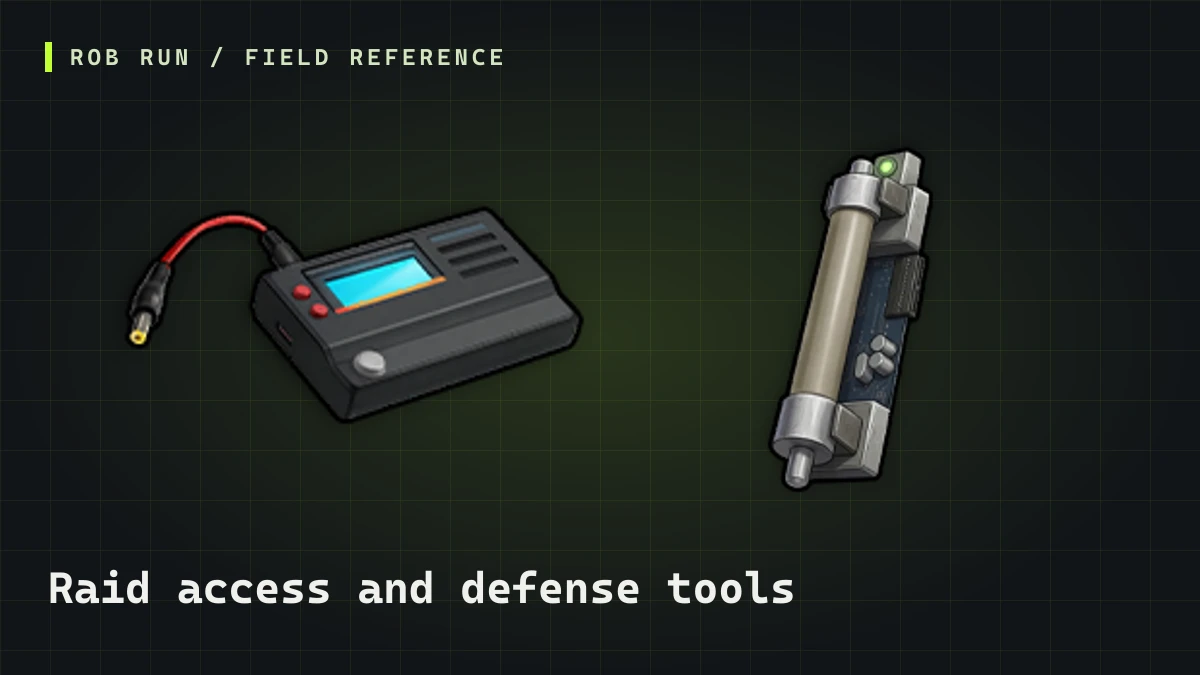
| Drill or Glass Cutter | A specific breach or exhibit objective | Confusing a general container tool with a heist tool |
| Decoder | Access associated with player buildings | Expecting city room keys to replace it |
| These are snapshot categories, not a complete current catalog. We do not confirm that a found key is permanent, reusable, traded freely or always consumed. Inspect the current tooltip and interaction prompt before spending a rare item. |
What examples help distinguish the layers?
The snapshot associates the bank’s outer vault with a Drill and an inner gold area with a bank ID. That makes “I have the bank card” insufficient preparation if the outer step still blocks access. The bank-vault plan explains the staged approach without copying a guaranteed loot table. For the art objective, the snapshot describes a Glass Cutter. For an ordinary locked room, it describes a named room key and potentially Mini Drills for large safes. Neither example establishes current quantities or charges. The barter guide explains how to confirm the output tool rather than buying something with a similar name.
Where do keys drop?
We cannot responsibly provide guaranteed locations or probabilities. The snapshot says keys can lead to further keys through containers, but a potential loot list is not proof of a fixed spawn. An empty container does not demonstrate that you went to the wrong building. Keep a small record of the full key name, destination text and lock message. Use the building scouting checklist to confirm the destination before carrying the key there. If the client does not state a destination clearly, postpone a costly expedition instead of guessing from an old screenshot.
How should you prepare for an unfamiliar locked room?
Plan the complete trip: access item, tools for visible or documented containers, carrying room, escape and buyer. Carry only the access items that serve that objective. Decide in advance to leave if the lock message does not match your plan. For a laboratory-related search, distinguish a research blueprint, a reagent, a building access item and a decorative or collection item with a scientific name. The laboratory guide covers the reported production chain; it does not establish a universal “lab key” that opens or unlocks everything. Treat similarly named items as different until the current client links them explicitly.
Editorial review: 27 November 2026. This is a source-based guide, not a claim of hands-on testing. Snapshot details may differ from the current client.