How is cargo different from ordinary loot?
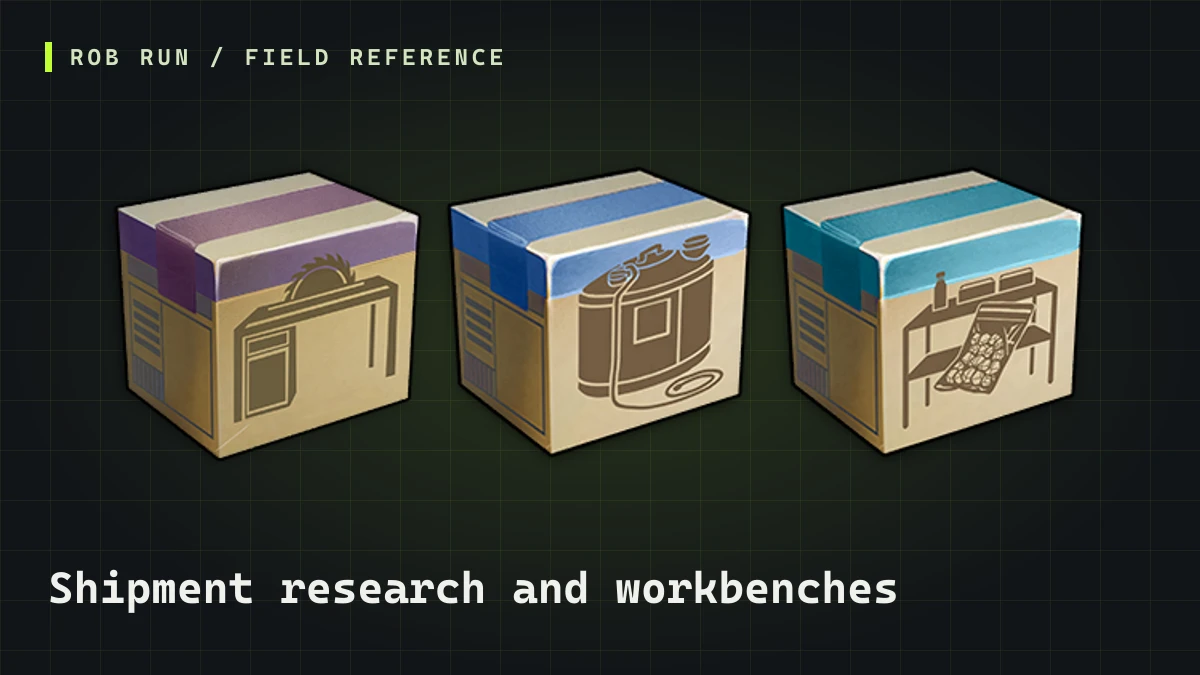
The community cargo snapshot treats cargo as a separate carrying category, often handled in the hands or vehicle cargo space rather than normal inventory slots. It also describes manufactured and collection crates, so a cargo item need not have been taken directly from a shop. We have not independently verified current capacities, trunk upgrades or handling restrictions. Before planning a large haul, check the actual vehicle and cargo prompts. Do not assume a larger ordinary inventory automatically provides more cargo capacity.
Should you sell a crate, open it or process it?
| Option reported in the snapshot | What you need to establish | Main commitment |
|---|---|---|
| Direct sale | A buyer that accepts the exact cargo | Transport and completion of the sale |
| Opening | A compatible Cargo Workbench and required equipment | Setup, processing time and handling the contents |
| Repacking or production | The correct machine, input and output chain | More capital and unfinished stock |
| Collection crafting | The current complete set and table requirement | Holding ingredients instead of selling them separately |
| A higher final listed value is not automatically a higher practical return. Count the inputs, machine purchases, time, additional transport and the risk of holding unfinished goods. The money guide suggests tracking completed payouts rather than assuming maximum theoretical prices. |
What equipment claims need checking first?
The snapshot associates cases and safes with opening equipment such as a cargo saw or plasma cutter, and contraband repacking with a separate workbench. A workbench name alone does not prove every cargo family is compatible. Read the machine’s accepted-input and required-module text. If it refuses an item, preserve the message instead of buying random upgrades. The shipment guide recommends unlocking a complete small chain, not collecting machinery that cannot yet do useful work.
What makes transport fragile?
The snapshot warns that dropped cargo can disappear and that police can confiscate cargo and bags. It does not establish a reliable current despawn timer. Do not leave valuable stock on the ground while assembling the rest of a route. It also labels the claim that drawing a weapon drops hand-carried cargo as unconfirmed. We keep it unconfirmed rather than promoting it into a rule. Check carrying behavior with low-value material where possible, and do not rely on a hidden grace period. Plan a destination before loading. Selling loot separates ordinary goods and cargo buyers, while loot loss explains why changing zone can change the risk rather than remove it.
Is a laboratory just another cargo opener?
No such equivalence is established. The snapshot describes a separate chemical-production chain through a reactor, freezer and lab table. The laboratory guide treats it as a project requiring connected stages, not a universal machine into which every crate can be placed. The snapshot itself is not fully consistent about where every harvest product sells. Its broad cargo rule names a Smuggler’s Van, while one grow-room paragraph names a Fence. We therefore do not print a universal buyer claim for every production output. Match the exact finished item to the current acceptance window before estimating profit.
What should you do before expanding production?
Complete one batch and one sale first. Record the input, resulting cargo name, accepted buyer and actual payment. Then decide whether additional capacity addresses a real bottleneck. A larger warehouse of unsold output is more exposure, not proof of a successful business.
Editorial review: 27 November 2026. This is a source-based guide, not a claim of hands-on testing. Snapshot details may differ from the current client.